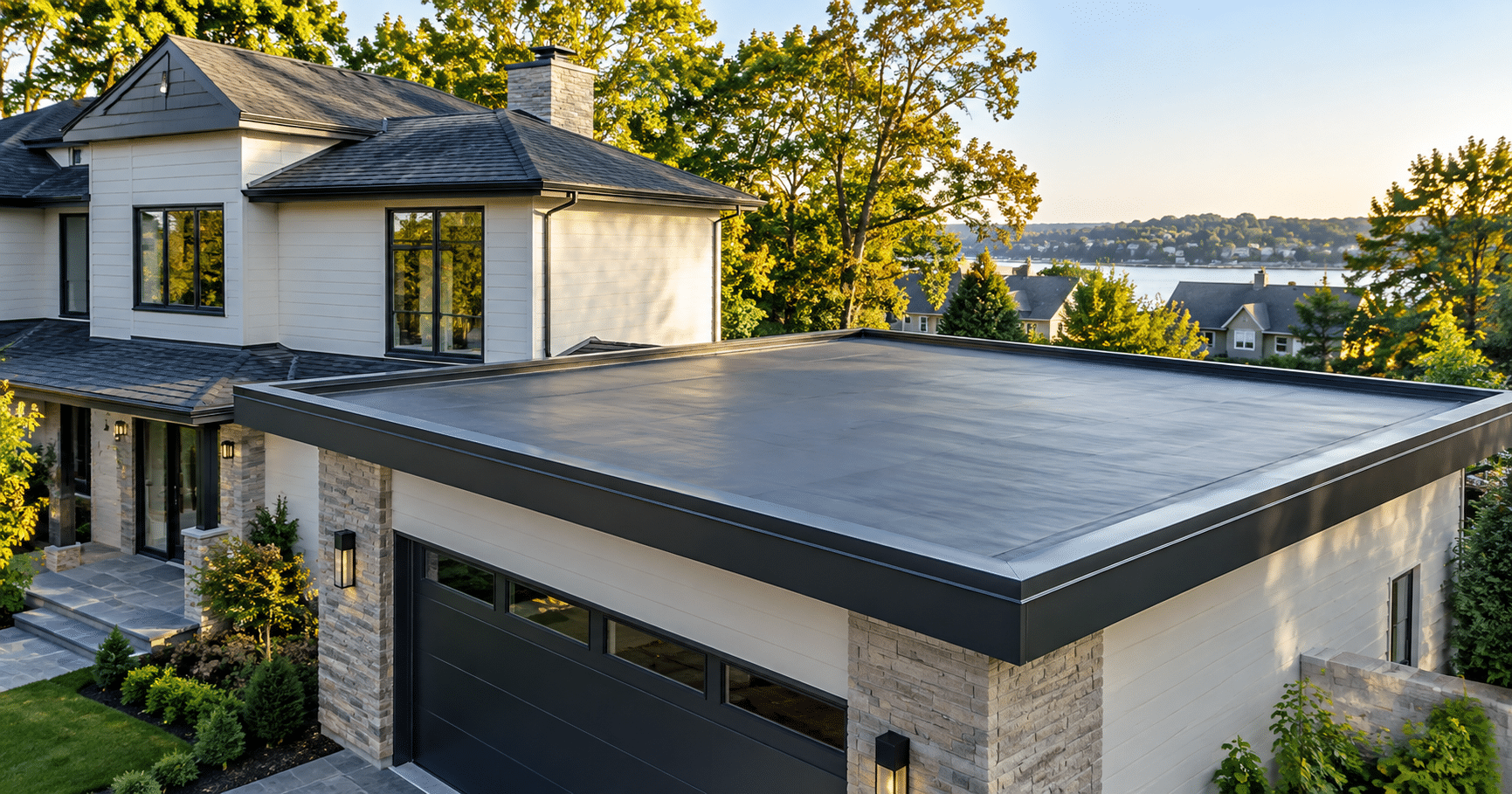
Most flat roof repairs make financial sense if the roof is under 15 years old and the damage covers less than 25% of the surface; beyond that, replacement usually costs less per year of remaining life. New Jersey’s freeze-thaw winters and humid summers accelerate that math faster than drier climates, which means the decision window is often tighter here than homeowners expect.
Why Flat Roofs Fail Differently in NJ
Flat and low-slope roofs don’t shed water the way a pitched asphalt shingle roof does — they rely on slight grading and drainage systems to move water off before it pools. In a state that swings from 15°F January nights to 90°F July afternoons, that assembly takes a beating. A rowhouse in Jersey City with a built-up roof (BUR) will show alligator cracking within 10-12 years as the asphalt layers dry out and contract, while a similar roof in a milder climate might last 18-20.
Ponding water is the most common early warning sign, and it’s a bigger deal on flat roofs than most homeowners realize. Standing water that doesn’t drain within 48 hours after a storm accelerates membrane breakdown, adds structural weight, and creates the ideal environment for algae and moss — all things inspectors in towns like Elizabeth and Paterson see repeatedly on older EPDM (rubber) roofs that were installed without adequate slope.
The Three Systems You’ll Encounter in NJ
- EPDM (rubber membrane) — most common on older homes and additions, typically 20-25 year lifespan, seams are the weak point
- TPO (thermoplastic) — increasingly popular replacement choice, reflective white surface helps with summer heat gain, 20-30 year lifespan
- Modified bitumen — torch-down or peel-and-stick, common on rowhomes and porches, 15-20 year lifespan
Knowing which system you have matters before you call anyone for a quote, because repair techniques and costs vary significantly between them. A seam failure on EPDM might be a $300-$600 fix; the same failure point on modified bitumen often requires a torch-down patch that runs closer to $500-$900.
When Repair Is the Right Call
- The roof is less than 15 years old and otherwise in good condition
- Damage is isolated — a single seam separation, a puncture from fallen debris, or localized flashing failure around a chimney or vent
- There’s no widespread ponding or soft spots when you walk the surface
- The insulation underneath is still dry (a moisture scan or simple probe test can confirm this)
A common scenario in towns like Cherry Hill or Montclair: a homeowner notices a small ceiling stain after a nor’easter, calls a roofer, and finds a single flashing failure around a plumbing vent. That’s a $400-$800 repair, not a $12,000 replacement — provided the rest of the membrane tests dry and intact.
When Replacement Is the Smarter Investment
- The roof is 18+ years old, especially for EPDM or modified bitumen systems
- You’ve had two or more repairs in the last 3 years — a pattern that usually signals the membrane itself is failing, not just isolated spots
- Ponding water covers more than a small, contained area after every rain
- Insulation underneath is wet or compressed, which shows up as soft, spongy spots when walked
- You’re planning solar panel installation, since most installers won’t mount on a roof with less than 10-15 years of remaining life
Take a duplex in Newark with a 22-year-old EPDM roof: the owner had patched three separate leaks in two winters, and each repair cost $500-$700. That’s $1,800 spent chasing a membrane that had already reached the end of its functional life — money that would have gone further as a down payment on a full TPO replacement.
The NJ-Specific Cost Breakdown
For a typical 1,500-square-foot flat roof:
- Spot repair: $300-$900 depending on system and location of damage
- Full EPDM replacement: $8,000-$12,000
- Full TPO replacement: $9,000-$14,000
- Modified bitumen replacement: $7,500-$11,000
Labor costs in North Jersey — closer to New York City — tend to run 10-15% higher than in South Jersey markets like Vineland or Bridgeton, so get quotes local to your specific county rather than relying on statewide averages.
A Factor Most Homeowners Miss: Insulation and Energy Code
NJ’s energy code has tightened insulation requirements for roof replacements since 2021, meaning a full tear-off now often requires adding rigid foam insulation to meet current R-value standards. That adds $1-$3 per square foot to a replacement project but wasn’t required on the original installation — which is one reason a quote today can look higher than what a neighbor paid for the same size roof five years ago. It’s not padding; it’s code compliance, and any licensed NJ roofer should be able to point to the specific requirement if you ask.
Making the Call
Walk through these questions before deciding:
- How old is the current roofing system, and does that match the typical lifespan for its material?
- Has this roof needed more than one repair in the past three years?
- Is there ponding water, or does a moisture scan show wet insulation underneath?
- Are you planning any major additions — solar, a roof deck, HVAC equipment — that would add stress to an aging system?
If your roof is young and the damage is contained, a repair is the responsible choice and there’s no reason to spend more. If you’re patching a system that’s already past 18 years or repeatedly failing in the same areas, replacement is the investment that actually stops the bleeding.
Get a Local Inspection Before You Decide
A phone estimate can’t tell you whether your insulation is wet or your membrane has years left — that requires someone walking the roof and probing it directly. Get two or three inspections from NJ-licensed roofers who work specifically with flat roof systems, ask each one to show you exactly what they’re seeing (photos of ponding, core samples of insulation, seam condition), and compare their findings before committing to either repair or replacement.